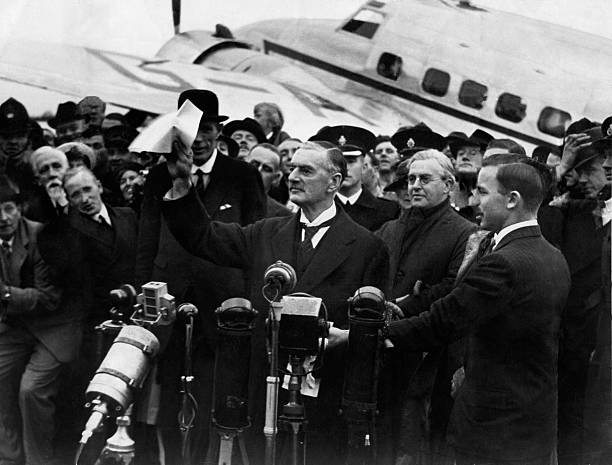
On September 30, 1938, Neville Chamberlain landed in London with a piece of paper in his hand and a phrase that history would take decades to digest: peace for our time. He had negotiated with Hitler. He had ceded the Sudetenland. He had convinced half the world that war was avoidable if you simply gave the monster what it asked for.
Eleven months later, German tanks crossed into Poland.
I tell this story because there is a phase of anxiety that nobody talks about, or at least nobody calls it by its name. It is the Chamberlain phase. The period in which you know perfectly well that you must go to war, that exposure therapy is the only path that exists, and yet you devote an extraordinary amount of energy to negotiating the terms of a surrender that lets you avoid it.
I lived in that phase for years.
There is a voice at the back of every anxious mind that is, in reality, an extraordinary diplomat. It doesn't always tell you to flee. Sometimes it offers you something far more sophisticated: a peace treaty.
The treaty works like this. You promise not to enter certain territories, not to do certain things, not to go to certain places, and in return the voice promises not to attack. It is a perfectly reasonable arrangement. There are zones on the map where you can move with relative freedom and zones where entry is forbidden. As long as you respect that border, there will be peace.
The problem, as Chamberlain discovered far too late, is that monsters don't respect treaties.
Every concession you make, every territory you cede, demands the next one. First it was the bicycle. Then it was any activity that raised my pulse. Then it was being alone at home for more than a couple of hours. The map of what was permitted shrank so slowly that it took me a while to notice I no longer fit inside it. In Morgenrot I call this the Schneckenhaus, the snail's shell. And it has one very important characteristic: the border always moves inward. Never outward.
The Chamberlain phase also has its own rhetoric, as elaborate as any parliamentary speech.
When I improve a little more, I'll expose myself. Now is not the right time, there's too much stress at work. In summer, when there's more light and I'm more rested. I've already improved so much in recent months that maybe I don't need to go that far. Perhaps my case is different.
I was a master of that rhetoric. I had arguments for everything. I knew perfectly well what had to be done — I had read it, I had worked on it in therapy, I understood it with a clarity that would have satisfied any examiner. And yet I kept not doing it, while building increasingly elaborate argumentative scaffolding to justify why this particular week wasn't the right one.
Appeasement is what that's called. The policy of giving the aggressor what it wants to avoid conflict. It works the same way on the political map as on the interior one: for a while, there is peace. And then the tanks cross into Poland anyway.
After a panic attack landed me in an ambulance on the way to hospital, that negotiating voice found its best raw material. The first attack, on a bicycle, I recount in Morgenrot. What the book doesn't tell in detail is what came after: entire months in which the bicycle sat parked while I specialised in perfectly valid reasons not to get back on it.
The cold of November. The snow of January. The rain of February. The ground still wet in March. Each excuse was impeccable on its own. Together they formed a non-aggression pact so solid that I had begun to believe it myself: the bicycle could wait, there was no hurry, the moment would come.
The moment came six months later, and it didn't come alone. It came pushed by my life partner, who had spent weeks looking at me with that combination of patience and firmness that only someone who knows you well can sustain. One day I simply stopped negotiating. I got on the bike.
The panic arrived like a negotiator who sees the treaty breaking down and decides to attack with everything. The palpitations, the cold sweat, the visceral certainty that something horrible was about to happen. But this time I didn't give in. I already knew that monsters are not appeased — they are walked through.
What I must say with absolute clarity is this: neither that ride nor the second nor the tenth were pleasant excursions on a sunny day. They were days of panic. One after another. That, slowly — very slowly — got better.
Recovery has no epic music in the background. It has dampness, and fear, and keep pedalling.
What nobody tells you about exposure therapy is that the hardest moment is not the first exposure. It is the moment before you decide you are going to do it.
Because that moment involves accepting something that the anxious mind has spent months or years refusing: that there is no possible negotiation. That no treaty will work. That the only path to freedom passes through exactly the place you fear most, without shortcuts, without diplomatic guarantees, without a signed paper certifying that you are going to survive.
That acceptance looks a lot like surrender. And in a way it is. Only what you surrender is not your territory, but your illusion that you could avoid the war.
Chamberlain took eleven months to understand that he had made a mistake. I took longer.
But the mechanism is the same: at some point, the evidence that appeasement doesn't work becomes impossible to ignore.
And then, almost without realising it, you cross the border you had spent so long guarding from the other side.
Do you recognise your own Chamberlain phase? What is the treaty you keep signing with yourself?